I asked Adelle's to share her favorite recipe with honey in honor of her birthday. It's a pretty simple recipe... Enjoy!
1) Acquire honey
2) Open jar
3) Eat honey
Facts and ramblings about my favorite bug, Apis mellifera, commonly known as the European Honey Bee.
Showing posts with label Comb. Show all posts
Thursday, May 28, 2015
Tuesday, May 5, 2015
Period Beehives: Wicker Skeps
A skep is an inverted basket made of
wicker or coiled straw used in beekeeping for housing bees. The skep is over
two thousand years old and straw hives are still used today in parts of Europe today.
There are many examples of skeps in
period illustrations and woodcuts. The word skep
is derived from the word skeppa. It
is Norse for a container and measurement for grain. It was not until the sixteenth
century that this term was used with regards to beekeeping. Before that, the
word “hive” was used.
The earliest known remains of a wicker
skep were from 1-200AD. The example came from a peat bog near Wilhelmshaven on
the North Sea coast of Lower Saxony. Wicker and coiled straw basket techniques
were known since Antiquity and could have been used as skeps then.
Wicker skeps, also referred to as an
alveary, were woven on a whorl of thin branches of a spruce or fir tree.
Dictionary.com defines a whorl as “a circular arrangement of like parts, such
as leaves or flowers around a point on an axis.” The branches formed the main
stakes. Other stakes were added for support as the diameter increased. Wicker
skep size and shape is determined by the size and shape of the whorl used.
Wicker hives were daubed with cloam or cloom. Cloaming
increases the weather resisting abilities of the hive. There are various
recipes for cloam, but the main ingredients are sand, ashes, dung and lime.
Straw skeps last longer than wicker. The cloam used to protect the hive adheres
better to the straw. This led to straw hives replacing wicker hives in later
years because of its ability to resist weather better.
Saturday, September 13, 2014
Friday, September 12, 2014
Modern Recipe: Honey Packed Peaches
It's canning season!
Honey was used in the middle ages and Renaissance as a preservative. It is still used to this day. Use honey instead of a sugar syrup to preserve your fruit.
Canned Peaches recipe found on Honey.com
Honey was used in the middle ages and Renaissance as a preservative. It is still used to this day. Use honey instead of a sugar syrup to preserve your fruit.
Canned Peaches recipe found on Honey.com
Ingredients
- 2-3/4 cups - water, divided
- 1/4 cup - lemon juice
- 5 lbs. - peaches*, peeled, pitted and cut into wedges
- 1-1/4 cups - honey
- 2 Tablespoons - vanilla extract
- 6 small - strips lemon zest
Directions
In a large bowl, mix 1/4 cup water and lemon juice. Stir fruit in gently, coating all pieces. Set aside. In a small saucepan, bring honey and remaining water to a boil. Remove from heat; stir in vanilla. Cover pan to keep contents hot. Pack fruit gently into 6 hot sterilized pint jars, filling to 1/4 inch from top of jar, and place a piece of lemon zest in each jar. Fill jars with honey mixture up to 1/4 inch from tops. Wipe rims of jars; top with lids. Screw on bands. Place jars on rack in canning kettle of hot water, adding water if necessary to bring water level to 1 inch above tops of jars. Bring water to a rolling boil; boil for 25 minutes. Remove jars carefully and cool on a wire rack. *Apricots or nectarines may be substituted.
TIP
Every honey variety has its own unique color and taste. There are approximately 300 varieties of honey in the United States - with flavors that range from delicately sweet to richly bold. In general, the lighter the color of honey, the milder the flavor. Try a light honey such as Clover or Orange Blossom in Honey Packed Peaches and Honey-Lemon Jelly. Experiment with a more robustly flavored honey such as wildflower or avocado when making Strawberry Jam or any of your favorite recipes.
Tuesday, August 19, 2014
History of Honey and Its use in Period: (Part 2 of 6): Honey Collection
( This is the second in a series of entries on a brief history of honey and its use in pre-1600's history.
Retrieving honey is the first step to its use. There were two
ways to eat the honey, straight from the combs or strained. The simplest way to
separate the honey from the comb is to break up the combs and squeeze each piece
into a receptacle. The first honey that dripped out was referred to as “Run
Honey”. Next, combs were put into a strainer, such as a bag of woven cotton or
other natural fiber or a pottery vessel with holes on the sides. Pressing the
combs through the strainer or bag made a second honey. This honey contained
pollen and was bitter. It was kept separate from the first honey. Columella describes
the process in Rome c. 50 AD[1]:
“Whatever be the number
of Honey combs that are harvested, you should make the honey on the same day,
while they are still warm. A wicker work basket or a bag rather loosely woven
of fine withies in the shape of an inverted cone, like that through which wine
is strained, is hung up in a dark place, and then the honey combs are heaped in
one by one. But care must be taken that those parts of the waxen cells, which
contain either young bees or dirty red matter [pollen?] are separated from
them, for they have an ill flavour and corrupt the honey with their juice.
Then, when the honey has been strained and has flowed down into the basin put
underneath to catch it…the fragments of the honey-combs, which have remained in
the bag, are handled again and the juice squeezed from them. What flows from
them is honey of the second quality and is stored apart by itself by the more
careful people.”
[1] Although
Columella is pre-period, he is referenced in period bee-keeping manuscripts
such as Thomas Hill’s “A Profitable Instruction of the Perfect Ordering of
Bees”, written in 1608.
Wednesday, August 13, 2014
Annotated Bib: "Small Scale Beekeeping", Curtis Gentry
Gentry, Curtis. Small Scale Beekeeping (PDF on Top Bar Hives). 1982. Found at:
Published by the Peace Corps to teach the usage of Top Bar Hives in developing countries. There are other resources found on the internet, but this is a free resource with basic information on using TBH's.
Friday, July 11, 2014
Burr comb at Four Weeks
Wednesday, July 9, 2014
Thursday, April 25, 2013
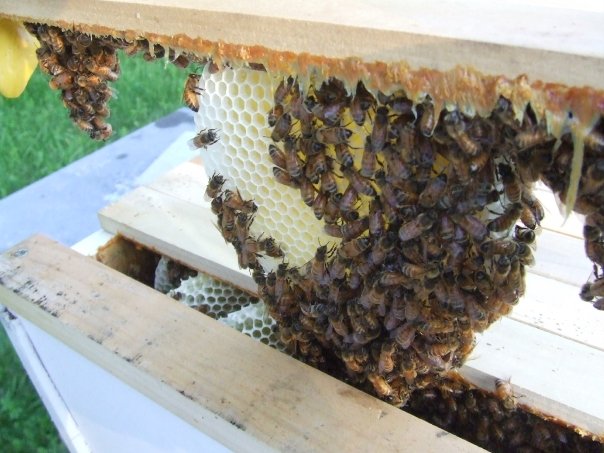
Modern Bee Pic #3
This is a picture of Top Bar Hive (TBH) honeycomb being drawn out and worked on the bar by the worker bees. The cream colored comb to the left is virgin comb. It's comb that has yet to be used for pollen, honey production, or raising young. It is one of the most beautiful things in the world to me.
At the top right of the picture, along the bottom edge of the bar, there is a substance that looks like melted Bit o' Honey. This is propolis. The bees manufacture it from tree sap. It is sometimes referred to as "bee glue". It is very sticky when warm or hot. Bees use it to fill in spaces and cracks they deem harmful to the hive.
The best reaction I get when showing people this picture or comb I have on hand is from kids. They see the comb and they are already in awe. Then I tell them the bees built it without using a ruler. Their eyes go wide and they get very excited. After that, I am usually unable to keep up with all of their questions.
Subscribe to:
Posts (Atom)


.png)